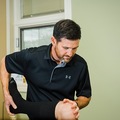
When you experience shoulder pain, it's natural to assume the problem is coming directly from your shoulder. But what if the real issue is somewhere else?
At Shaw Spine & Sport, we understand that the body works as an interconnected system. One area that is frequently overlooked when evaluating shoulder pain is the thoracic spine, also known as the mid-back.
Limited thoracic mobility can affect how your shoulders move, contribute to poor posture, and place additional stress on surrounding muscles and joints.
Whether you're an athlete performing overhead movements, someone who spends hours sitting at a desk, or simply struggling to reach overhead without discomfort, improving thoracic mobility may be an important part of restoring normal movement.
What Is Thoracic Mobility?
The thoracic spine is the middle portion of your back, consisting of 12 vertebrae (T1–T12). It connects your neck to your lower back and serves as the attachment point for your ribs.
Unlike your lower back, which primarily allows forward and backward bending, the thoracic spine is designed to provide a combination of stability and mobility.
Two particularly important movements include:
- Thoracic extension: The ability to straighten and extend your upper back.
- Thoracic rotation: The ability to twist your upper body from side to side.
These movements are essential for everyday activities such as reaching overhead, turning to look behind you, lifting objects, and participating in sports.
When your thoracic spine becomes stiff, other areas of your body often compensate for the missing movement.
And one of the areas most affected is your shoulders.
The Connection Between Thoracic Mobility and Shoulder Pain
Your shoulder is one of the most mobile joints in your body. However, achieving healthy shoulder movement requires much more than just the shoulder joint itself.
Your shoulder blade, or scapula, plays a critical role.
Your Shoulder Blade Depends on Your Rib Cage
Unlike many other joints, your shoulder blade doesn't have a direct bony connection to your rib cage. Instead, it glides across the surface of your ribs, supported and controlled by surrounding muscles.
This relationship is known as the scapulothoracic articulation.
Because your ribs attach directly to your thoracic spine, the position and movement of your mid-back influence how your shoulder blade moves.
Think of your rib cage as the foundation for your shoulder blade.
If that foundation isn't moving properly, your shoulder blade may struggle to move efficiently.
When you raise your arm overhead, your shoulder blade must rotate upward, tilt backward, and adjust its position along the rib cage.
A stiff thoracic spine can interfere with these movements, potentially contributing to shoulder discomfort and restricted range of motion.
Why Thoracic Extension and Rotation Matter
Reaching overhead requires coordinated movement between your shoulder joint, shoulder blade, and thoracic spine.
Some movement models estimate that approximately 10–15 degrees of thoracic extension contributes to full overhead shoulder motion.
Thoracic rotation is equally important, particularly during activities such as throwing, swinging a golf club, swimming, and other athletic movements.
Approximately 45 degrees of rotation is sometimes used as a general reference for functional thoracic movement.
These numbers aren't strict requirements for everyone. What's most important is having enough mobility to perform your activities without excessive compensation.
When your thoracic spine lacks extension or rotation, your body must find that movement somewhere else.
Unfortunately, that often means placing additional stress on your shoulders, neck, or lower back.
How a Stiff Upper Back Can Contribute to Shoulder Problems
One common finding in individuals with limited thoracic mobility is an excessively rounded upper-back posture.
This is often referred to as increased thoracic kyphosis.
It's important to understand that some degree of thoracic kyphosis is completely normal. Your spine naturally has curves that help distribute forces and support movement.
However, when the upper back becomes excessively rounded or loses its ability to extend, it can change the resting position and movement of your shoulder blades.
This may contribute to:
- Difficulty reaching overhead
- Reduced shoulder range of motion
- Increased stress on the rotator cuff
- Shoulder discomfort during lifting
- Neck and upper-back tension
- Altered shoulder blade mechanics
Over time, these movement limitations may become particularly noticeable during repetitive activities.
The Overcompensation Trap
Your body is incredibly good at finding ways to complete a movement, even when certain joints aren't functioning optimally.
But those compensations can come at a cost.
Imagine trying to reach overhead when your upper back is stiff and rounded.
Instead of your thoracic spine extending and your shoulder blade moving freely, your body may compensate by arching your lower back, elevating your shoulder, or relying more heavily on the muscles surrounding the shoulder joint.
The rotator cuff muscles, which help stabilize and control the shoulder, may have to work harder to maintain proper movement.
Repeated compensation can increase mechanical stress on shoulder structures and may contribute to irritation or pain in susceptible individuals.
This is one reason treating shoulder pain shouldn't always focus exclusively on the shoulder itself.
Sometimes, improving how the mid-back moves is an important part of the solution.
Thoracic Mobility and Athletic Performance
Thoracic mobility becomes especially important for athletes who frequently rotate their upper bodies or perform overhead movements.
Baseball and softball players, swimmers, volleyball players, tennis players, golfers, and weightlifters all depend on coordinated movement through the thoracic spine.
Consider a baseball pitcher.
Generating an effective throw requires a sequence of movements beginning with the lower body, transferring through the hips and trunk, and ultimately reaching the shoulder and arm.
If the thoracic spine cannot rotate effectively, the athlete may compensate by placing additional demands on the shoulder or lower back.
Similar movement challenges can occur during swimming, overhead pressing, serving a volleyball, or swinging a golf club.
Adequate thoracic mobility can help support:
- Efficient overhead movement
- Better coordination between the trunk and shoulders
- Effective transfer of force during athletic movements
- Improved movement quality
- Reduced reliance on compensatory movement patterns
While thoracic mobility alone cannot prevent every injury, it is an important component of a comprehensive approach to athletic performance and musculoskeletal health.
How Everyday Habits Affect Thoracic Mobility
You don't have to be an athlete to experience thoracic stiffness.
In fact, many people develop limited mid-back mobility through their everyday routines.
Spending extended periods sitting at a desk, working on a computer, looking down at a phone, or remaining in the same position for hours can contribute to feelings of stiffness.
When we consistently move through a limited range of motion, we may gradually become less comfortable moving outside that range.
However, posture itself isn't necessarily harmful. There is no single perfect posture, and sitting with a rounded back doesn't automatically cause pain.
The bigger concern is often a lack of movement variety.
Our bodies are designed to move, and regularly changing positions helps maintain comfort and movement capacity.
For individuals who spend much of their day sitting, addressing thoracic mobility may help improve how their upper back and shoulders function during daily activities.
Can Limited Thoracic Mobility Cause Neck or Lower Back Pain?
Although thoracic stiffness is frequently associated with shoulder limitations, its effects can extend beyond the shoulders.
The spine functions as a connected system.
When one region doesn't move adequately, neighboring regions may compensate.
For example, someone with limited thoracic extension may arch excessively through their lumbar spine when reaching overhead.
Similarly, someone who cannot rotate effectively through the mid-back may rely more heavily on movement through the neck or lower back.
These compensations don't automatically cause injury, but they can increase mechanical demands on surrounding structures.
For this reason, evaluating thoracic mobility may be beneficial when addressing certain cases of:
- Neck pain and stiffness
- Upper-back discomfort
- Shoulder pain
- Limited overhead movement
- Lower-back pain
- Sports-related movement limitations
Understanding how different regions of the body work together allows us to develop a more comprehensive treatment approach.
How We Address Thoracic Mobility at Shaw Spine & Sport
At Shaw Spine & Sport in Clive, Iowa, our goal isn't simply to address the area where you're experiencing pain.
We want to understand why your body isn't moving the way it should.
When evaluating someone with shoulder pain or upper-back stiffness, we may assess thoracic mobility, shoulder range of motion, muscle function, posture, and overall movement patterns.
Depending on our findings, treatment may include several approaches.
Chiropractic Manipulation and Mobilization
Chiropractic adjustments and joint mobilization techniques may help improve movement in restricted areas of the thoracic spine.
These treatments are selected based on the individual's examination findings, symptoms, and tolerance.
Soft Tissue Therapy
Muscles surrounding the thoracic spine, rib cage, and shoulders can contribute to movement restrictions.
We may incorporate soft tissue techniques to address muscle tension and improve comfort during movement.
Corrective Exercise and Rehabilitation
Improving mobility is only one part of the process.
We also want patients to develop the strength, coordination, and control necessary to use their available movement effectively.
Our rehabilitation approach emphasizes restoring normal movement patterns and helping patients maintain their progress.
Individualized Treatment Plans
Not everyone with shoulder pain has limited thoracic mobility, and not every mobility restriction requires treatment.
That's why we emphasize individualized assessments rather than assuming the same approach will work for everyone.
Our goal is to identify the factors contributing to your symptoms and develop a plan that helps you return to the activities you enjoy.