If you’re a runner dealing with pain, trying to prevent injury, or simply wanting to run more efficiently, an exam is a smart place to start. At Shaw Spine & Sport, a runner’s first visit includes more than just a conversation about symptoms. We also perform a functional exam to assess how your body moves, identify mobility or strength limitations, and better understand the factors that may be affecting your running. That part matters. But even a thorough functional exam has limits.
A functional exam helps us evaluate what your body can do in a controlled setting. A 3D gait analysis helps us see what your body is actually doing while you run.
That distinction is important.
A Basic Exam Gives Important Clues
A runner’s first visit should absolutely include a detailed history and functional assessment. At Shaw Spine & Sport, your gait analysis assessment includes a review of your training or activity routine, a functional movement assessment, footwear evaluation, and a personalized plan based on your findings.
During a functional exam, we may look at things like:
- Hip mobility
- Ankle motion
- Balance and control
- Strength deficits
- Single-leg stability
- Movement quality during basic tasks
This gives us valuable information. It can help explain why you may be dealing with issues like plantar fasciitis, shin splints, runner’s knee, Achilles pain, or hip discomfort. It also helps us identify restrictions or weaknesses that may need to be addressed as part of treatment or rehab.
But the exam still happens outside of actual running.
What a 3D Gait Analysis Adds
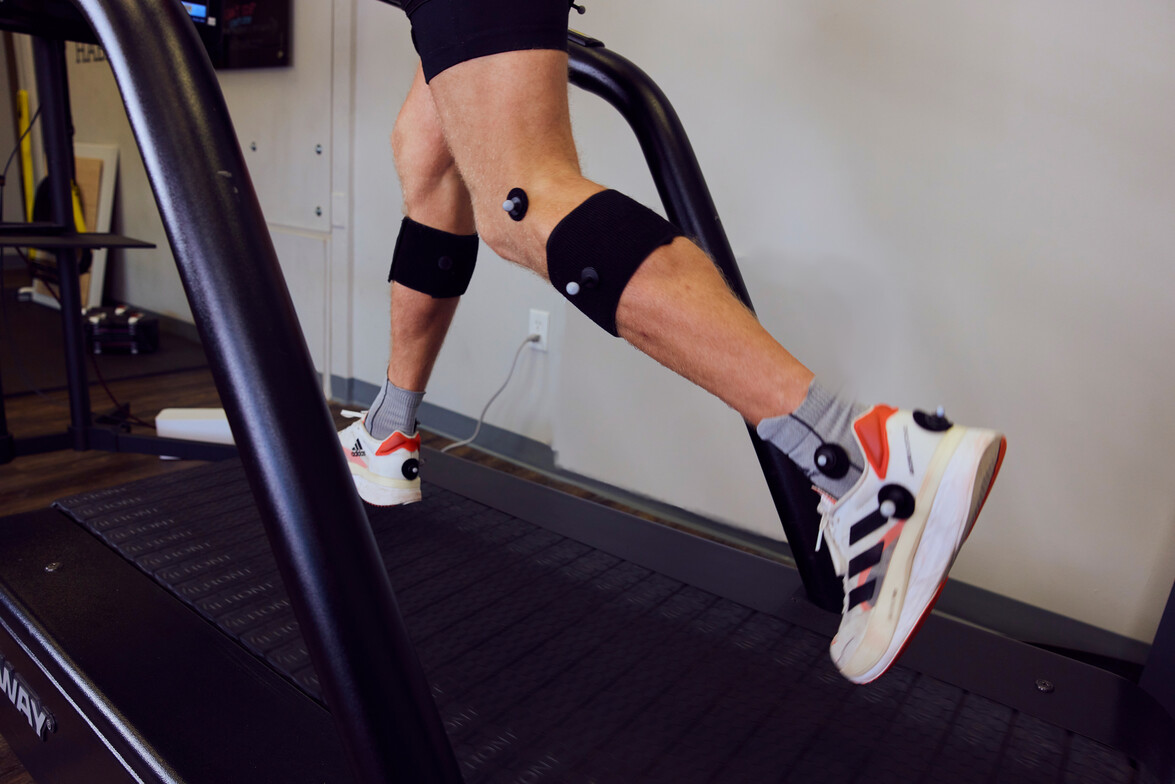
A 3D running gait analysis looks at movement dynamically, during the activity itself. Shaw Spine & Sport’s service page explains that the assessment captures three-dimensional data on joint motion, limb positioning, and movement timing using multiple cameras and motion-analysis software.
In other words, it shows what happens once your body is in motion and under load.
That matters because many running problems do not show up clearly when you are standing still or performing isolated movements on an exam table. Shaw Spine & Sport notes that gait analysis evaluates movement as it occurs during walking or running, and that many injuries are influenced by compensations happening away from the area of pain.
What 3D Gait Analysis Can Reveal That a Basic Exam May Miss
1. Real-time movement patterns
A functional exam may show that you have enough strength or mobility in a certain area. But when you start running, your body may still compensate.
A 3D gait analysis can help identify:
- Overstriding
- Excessive vertical movement
- Prolonged ground contact time
- Frontal plane collapsing
- Loading asymmetries from side to side
- Compensation patterns that only appear at running speed
Shaw Spine & Sport specifically highlights factors such as overstriding, ground contact time, and vertical displacement as patterns commonly evaluated during a 3D running gait analysis.
2. Where stress is really going
Pain is not always coming from the place that is causing the problem. Someone with knee pain may actually be overloading that area because of poor control higher up at the hip or a foot strike pattern that increases stress below.
Because 3D gait analysis examines how forces are distributed through the body and where breakdowns may be occurring, it can provide insight that a basic exam alone may not fully capture
3. How your mechanics change under demand
It is one thing to perform a single-leg squat in a clinic. It is another thing to repeat hundreds or thousands of strides during a run.
Running places different demands on the body than static testing, and gait analysis examines higher-impact movement patterns, including stride mechanics, joint loading, and force absorption.
That means a runner may “pass” parts of a basic exam and still show mechanical inefficiencies once they begin running.
4. Objective data to guide a plan
A basic exam helps form clinical impressions. A 3D gait analysis adds measurable information that can help guide treatment, rehab, cueing, and return-to-run decisions.
At Shaw Spine & Sport, the results are used to develop an individualized plan focused on mobility, strength, coordination, running form, and ongoing support.
Why Both Matter
This is not an either-or situation.
An exam and functional evaluation are essential because they help us understand your injury history, limitations, training habits, and physical capacity. A 3D gait analysis builds on that by showing how those findings play out in actual running.
That combination is what makes the evaluation more complete.
Instead of guessing based only on symptoms or static movement screens, we can connect the dots between:
- What you feel
- What your body shows in an exam
- What your running mechanics reveal in motion
Who Can Benefit From 3D Gait Analysis?
3D gait analysis can be especially helpful for runners returning from injury, people with recurring lower-body pain, and those beginning a new training program who want to build efficient movement habits early. The clinic also lists common conditions assessed with gait analysis, including iliotibial band syndrome, patellofemoral pain, hip pain during running, plantar fasciitis, shin splints, Achilles tendon pain, and stress-related bone injuries.
That makes it useful for runners who want answers beyond a basic exam alone.
What to Expect at Shaw Spine & Sport
When you come in for a running assessment at Shaw Spine & Sport, your visit is not just about watching you jog on a treadmill. The assessment includes:
- Review of your current training or activity routine
- Functional movement assessment
- Footwear evaluation
- Walking and/or running gait analysis using 3D motion-capture software
- A personalized plan based on your findings
- Ongoing support and progress guidance
That means your first visit already includes the functional exam piece. The 3D analysis simply takes things a step further by showing how you move when it counts most: during the act of running.
The Bottom Line
A basic exam is important, but it does not always tell the whole story for runners.
A functional exam can reveal mobility restrictions, strength deficits, and movement limitations. A 3D gait analysis can reveal how those issues show up during real running mechanics, including stride patterns, loading strategies, compensations, and inefficiencies that are easy to miss in a standard evaluation. Shaw Spine & Sport combines both approaches as part of its gait analysis assessment, which helps create more individualized recommendations for training, rehabilitation, and recovery.
If you’re dealing with a recurring running injury, trying to improve efficiency, or wanting a clearer picture of how you move, a 3D gait analysis may provide answers that a basic exam alone cannot.
Ready to learn more about your running mechanics? Shaw Spine & Sport offers 3D running gait analysis in Clive, Iowa, with assessments designed to better understand movement patterns and guide individualized care.